
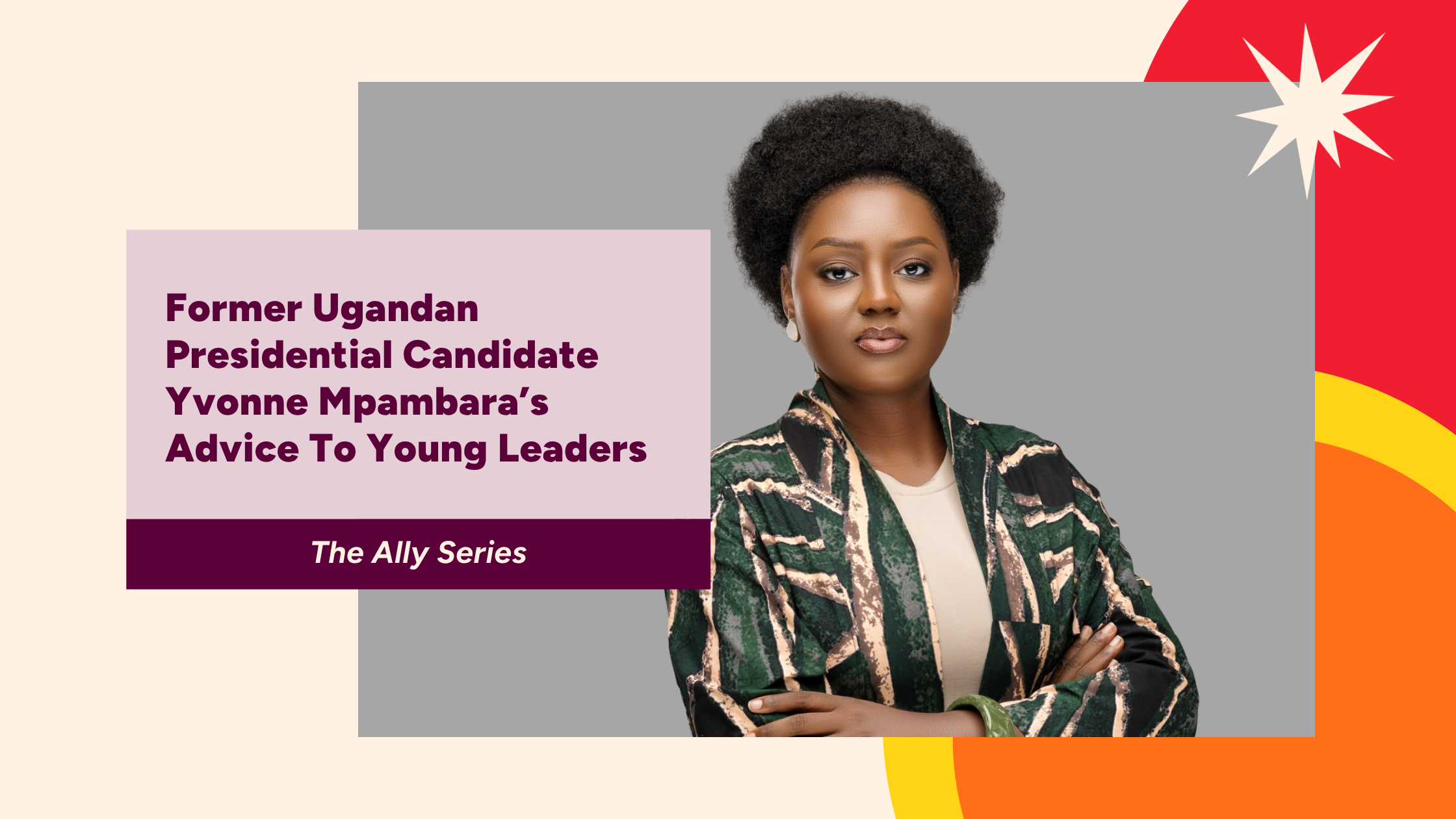


Ugandan lawyer and activist Yvonne Mpambara took the next step in her career by announcing her intent to run for President of Uganda in the 2026 national elections.
And then the comments started.
Baby. Sweetheart. Darling. “You have nice lips.” All of this and more she endured on the campaign trail and online, in what she describes as “one of the most disrespectful periods of my life.”
But her presence — and her vocal advocacy about what she experienced — sent a powerful message about the importance of female representation at the highest levels of government.
“I intentionally penetrated the political space to fight for women to lead,” Ms. Mpambara has said. “And putting myself forward exposed me to the highest levels of objectification.”
She has since founded the Foundation for Female Presidential Aspirants (FFPA), an organization that nurtures women as future presidents of nations across Africa.
Her commitment to paving the way for women and girls to be recognized as leaders makes Yvonne Mpambara an ally that we at Global Catalyst are honored to celebrate. Her belief in challenging gender norms and stereotypes to help young women expand their vision of what’s possible is the same spirit that fuels our own global programs — and we’re thrilled to share her advice and insights with girls around the world.
In the latest edition of our new Q&A, The Ally Series, we caught up with Yvonne Mpambara to hear her reflections on the power of finding your voice, where she’s taking her advocacy work next, and the advice she has for girls who want to speak up, but aren’t quite sure where to begin.
Here’s what she had to say.
What does being an ally mean to you, and how do you make an intentional effort to show up for girls and women?
Being an ally, to me, is a practice I am accountable to — not just a title. It means using whatever proximity to spaces, platforms, and power I have to open or widen doors for someone else. Because it doesn’t have to just be me walking through those doors.
Having spent several years working at the intersections of security, human rights, governance and social justice, I have understood that a lot of systems were not built with women and girls in mind. Being a real ally shows in the decisions one makes even when no one is watching:
Who do you recommend for opportunities? Whose name do you forward for roles? Who do you credit in a room? How do you speak about women?
In systems such as security and governance, for example, where women have been sidelined for centuries, it means insisting on their presence. They should not be consulted as an afterthought.
“I want women to have and hold political power unapologetically.”
Allyship means being honest about the discomfort that comes with sharing space and power. We should not be comfortable with assuming that allyship should not come at a cost. Sometimes, it is difficult to hold myself to this standard, but I have tried my best to make it my bible.
I founded the Foundation for Female Presidential Aspirants (FFPA) for this particular reason. Having gone through a tough presidential race myself, I realized that I do not want women to simply exist to vote, and or be invited into governance and politics after the important decisions have been made.
I want women to have and hold political power unapologetically. They deserve to build powerful networks and have the strategic capacity and knowledge that enable them to run nations. They deserve the financial and economic agency that propel them into power.
When did you realize your voice could create change, and how have you used it to speak up for something you believe in?
There was not a single big bang or dramatic boom. There is a common phrase people use: “It comes at you fast.” But this was no such thing. It was a slow realization.
Through years of advocacy work and being at the forefront of human rights defense work holding power accountable, you realize that silence has a cost. A cost far uglier than speaking up and fighting for what is right. Someone has to be willing to name what is happening even when it is either unsafe or uncomfortable. Because silence is never neutral.
When systems and institutions fail people, when the laws meant to protect reproduce inequality, when we are told that our concerns are too political, remaining silent entrenches systems that stay operational without being challenged. This is the part where I realized that my voice has to be a tool for naming and shaping realities and facing and asking those questions that systems do not want to answer.
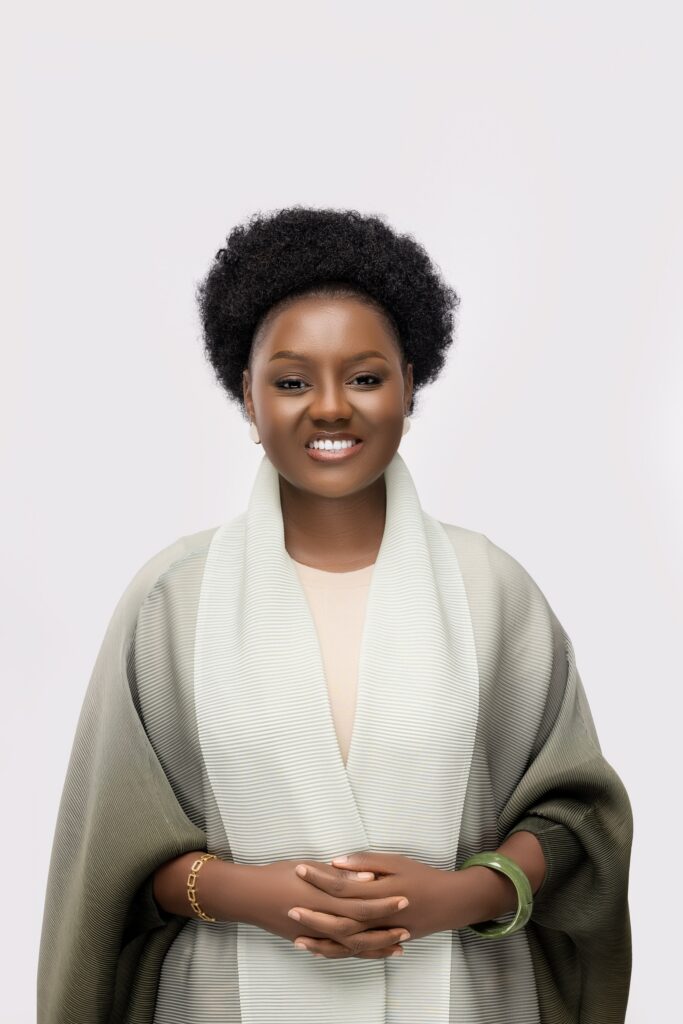
I moved into spaces where women, especially African women, are consistently underrepresented. Strategising in Security, for example, has reinforced my belief that security is not simply about borders, weapons or state institutions alone. It is about whether people can live, organize, participate, and lead without fear.
My work — building political infrastructure around presidential politics that can be owned by communities and ordinary citizens who are usually sidelined — challenges me to think beyond just getting individuals into power, but to envision a much bigger system: one where women presidents are a normal part of life.
Announcing my candidacy in the 2026 Uganda Presidential race was, in many ways, one of my strongest uses of my voice. I realized that I have to move beyond advising from the margins, working from around the systems and getting into the arena to get dirty.
It invited heavy scrutiny, of course, but I expected that. That is the whole point. You enter a dirty arena, get dirty, and strategize on how to clean it. We have to normalize getting the work done ourselves. The way men are running nations has been quite disastrous. We have to get into these spaces and refuse to apologize for being there. It is what we call, “Moving with the audacity of men.”
Can you share a meaningful moment in your advocacy journey that reinforced why this work matters to you? What did you learn from that experience?
I was having a chat with a powerful woman who had been a presidential candidate in a previous presidential race. She told me, “Ms. Mpambara, have you noticed that even when a woman makes it onto a presidential ballot that has 8 men and more, they never make it back on the ballot in other presidential races?” Of course, some would argue that the presidential race is a race based on merit. Oh, boy, do people love saying that!
But if we are being honest, continuously appearing on a presidential ballot builds power. It builds your networks, and it keeps you in the game. Women are automatically cut off from all of that.
I’m also reminded of another moment. I have coordinated security responses for human rights defenders, women caught on the wrong side of repressive legislation, and organizers who use their voices to hold power accountable. Behind every security incident, there is a real person. Their sense of security, work, family, and wellbeing can be disrupted at any moment. This is invisible work that is very demanding. But building systems to identify and respond to threats made me realize that protection cannot remain an aspiration just written in policies. It has to exist in practice.
This translates into how I relate with security and governance in general. Our governments may have perfectly jotted-down laws on paper. But if citizens cannot exercise their rights, speak, challenge, and organize around power, then something is fundamentally wrong.
I have learned that we cannot design solutions far from those experiencing the challenges we want to address. Those facing the problem must be at the heart of the solutions and at the decision-making table.
I am interested in building political leadership models and institutions that are responsive to the realities of people, rather than simply reproducing systems that already exist.
What is something girls or young women have taught you that has influenced the way you live, lead, or advocate?
Working alongside young women has taught me that boldness does not need permission.
Through youth diplomacy networks, feminist spaces, mentorship programs and political leadership work, I have encountered phenomenal young women who are willing to ask uncomfortable questions, challenge institutions, and demand accountability with a clarity that is sometimes lost as we become more accustomed to the limitations of the systems around us. They remind me that what we sometimes call “realism” can become an excuse for accepting things that should actually be changed.
They have taught me that leadership does not have to wait for a title. Nor does it have to wait for age or position.
Young women are some of the most profound, sophisticated political thinkers you will encounter. They may not necessarily hold office but they understand their communities. They use their conviction and voices to speak to the realities of their communities. They always have the courage to articulate what needs to change. Watching them operate without waiting for institutional permission to get things done has truly made me impatient with my own role, ambition, and instinct to defer or wait my turn.
“Young women are some of the most profound, sophisticated political thinkers you will encounter. They may not necessarily hold office but they understand their communities. They use their conviction and voices to speak to the realities of their communities. They always have the courage to articulate what needs to change. “
This is how my understanding of leadership has changed. It is not just a matter of being in the arena myself. As a leader, I have to create the conditions in which people can develop the confidence and capacity to occupy seats and do the work themselves.
If women and young people are already thinking clearly about what needs to change, my job is to build the room, the whole house, and the systems for them to say it in — not just speak on their behalf.
Thinking back to your younger self, what is one piece of advice you would give a girl who has an idea for change, but isn’t yet confident enough to act on it?
I would tell her that there will always be a reason to feel unqualified. I would tell her that confidence is a by-product of action, not a prerequisite for it.
Being ready arrives some time in the middle of doing whatever it is you were afraid to begin. Waiting to be ‘ready enough’ or be ‘confident enough’ is one way of asking for permission that no one will ever hand to you.
Never underestimate the power of beginning, no matter how small it feels. One person believing in you is enough. I remember a dear relative telling me, “ Who would ever stop you if you wanted to be president? You have been raised to lead nations!” Another friend once told me, “I have seen how determined and hard you work. It doesn’t surprise me one bit about the journey you choose to travel every day.” That was enough validation for me.
I would remind my younger self that fear never completely goes away. Oh, dear friend, there is fear. A lot of it. Fear changes versions at every stage of what you intend to do. It will cast a shadow asking you, “Who are you to do this? If others have not succeeded, who do you think you are to succeed?” This doubt is normal. But, I have learned not to use it as a determinant not to act. Doing what matters is all the prerequisite you need.
Do it scared if you have to. Let your voice and hands shake, but do it!
Lately (and this is helpful when the criticism and the pedal stores become heavy): Rejection is not a verdict on your potential, or a reason to resign from pushing harder. There are several rooms that will reject you. Some spaces will try to destroy you, others will use you and toss you out, saying that you do not belong. But none of that should ever kill your spirit.
There is something that amuses me about zodiac signs. I was born right in the middle of the Zodiac Leo. The wild cat is described as the only animal that hunts during storms. You know what, that is exactly who I am. My best battles are fought in storms. I long for the calm but I am a vicious hunter. This courage and vicious nature pushes me into spaces where I am not expected to be or survive.
What’s next for you, and what impact do you hope to make?
I hope to create an impact that is structural. I am particularly interested in what it takes for women to move from participation to power. We often celebrate women for entering political spaces, but entering is only the beginning. Women need the resources, political strategy, economic independence, institutional knowledge, security, networks and political sponsorship required to compete effectively and govern.
This is especially important at a time when organized anti-rights and anti-gender movements are increasingly challenging women’s rights, democratic participation and inclusive governance. I want my work to help ensure that women are not simply defending the space they have gained, but are building enough power to shape the future of that space.
I am building towards my 2031 presidential ambitions. I am building a manifesto centered on three core mandates: Economic growth, social development, and foreign policy and regional integration. I am working towards a Uganda That Works for Us All and towards power shifting hands.
Through this, I am mentoring movements of emerging leaders, generations emerging alternative visions for our country Uganda and our region and continent at large. I invite all global partners and well wishers to work with me to push for women’s political power and women on the presidential ballot.
Ready to meet more inspiring changemakers? Check out, “Reflections on Voice, Power, and Change from Musician and Activist Kiran Gandhi.”
Global Catalyst mentors girls around the world to become powerful advocates and confident leaders. Our signature program, GLOW Club, connects girls in some of the world’s most underserved areas with trusted local mentors and a safe space to express themselves as they develop their agency, find their voice, and build their power. Since our founding, we’ve ignited the power of more than 100,000 girls, sparking a growing movement of youth-led change that is transforming communities — and the world — for the better.