



This past August, Meta agreed to pay roughly $17 billion to settle claims from 52 state attorneys general that it knowingly built Facebook and Instagram to be addictive for young users and harmful to girls’ mental health.
It’s the largest settlement of its kind. And while Meta has denied the allegations, the settlement requires substantial changes across Instagram and Facebook for teens: a two-hour daily cap on app usage, a midnight-to-6-a.m. “night mode,” the removal of like counts for anyone under 18, and the option to turn off autoplay and the personalized algorithmic feed.
In a world where social media is increasingly pervasive, this is an important step forward in protecting girls’ mental health — one we’ve been hoping to see for a long time.
It’s also a moment worth pausing on. Because for girls specifically, some of these changes matter more than others. And there’s real work still ahead to make sure they have a lasting impact.
How the algorithmic feed harms girls’ mental health
Every one of Meta’s changes responds to issues that have impacted teens’ mental health: most notably, a feed engineered to keep a teenager watching an endless stream of content, even if it may be harmful. For girls, that’s not an abstract concern.
Research on teen social media use has consistently found that girls are more exposed to appearance-focused, comparison-heavy content than their male peers — largely because that type of content is exactly what feeds an engagement-driven algorithm.
It’s a pattern we’ve noticed for adolescent girls around the world: the sense that their feed, without them ever searching for it, keeps circling back to the same messages about how they should look, feel, and think as a girl.
“When I was in middle school, some of my peers often compared themselves to models and how they wished to have the ‘dream’ body like the models they idolized,” one of our program participants told us. “Unfortunately, those idealistic beauty standards that bombarded my classmates’ social media feeds did not come with disclaimers. As a result, they believed that looking like a 20-year old model was possible, when in reality, it was an unattainable goal for pubescent teenagers who were beginning to develop into their own.”
That’s why the option to turn off the algorithmic feed and hide like counts stands out to us as much as the required two-hour time limit does. A time limit reduces how long a girl is exposed to a harmful pattern. But removing the mechanism that creates the pattern goes a step further: It can change whether the pattern gets manufactured in the first place.
For girls — a group of users research has shown are most affected by content like this — that’s the piece worth paying closest attention to as these features roll out.
Girls are powerful advocates for their own mental health. And they deserve to have online spaces that value their well-being, too.
Why girls need digital literacy to navigate these changes
Most of these changes take effect automatically for teen accounts. The two-hour daily limit, night mode, removal of like counts, and stronger age verification are all built in by default.
Two of the most significant protections, though, aren’t: The option to turn off autoplay and switch to a non-algorithmic feed both require a parent or teen to actively go into the account settings and turn them on. Meta isn’t requiring teen accounts to use either one.
That’s the reason we’re paying close attention to what happens next, and how these changes are rolled out. A non-algorithmic feed only helps a girl if she knows the personalized version was built to keep her scrolling, and knows that the option exists to turn it off. The same goes for autoplay.
These two protections only work if a girl — or a parent — understands what she’s opting into, and why it matters.
That’s exactly why digital literacy deserves to be talked about in the same space as this settlement. Real digital literacy means understanding that social media algorithms take users through an endless loop of content that will start to shape your thoughts, behavior, and perception of yourself if you don’t outsmart it.
While adults are largely responsible for digital safeguarding, a girl who understands it for herself is in a much stronger position to most meaningfully benefit from these new protections, unlearn harmful thoughts and behaviors she may have developed, and recognize the same design patterns on the next platform that comes along.
At Global Catalyst, that’s why we stand with girls when they advocate for digital access and education. Because digital literacy begins with ensuring girls can recognize the systems that shape what they see, do, and experience online.
Why safe spaces matter beyond the screen
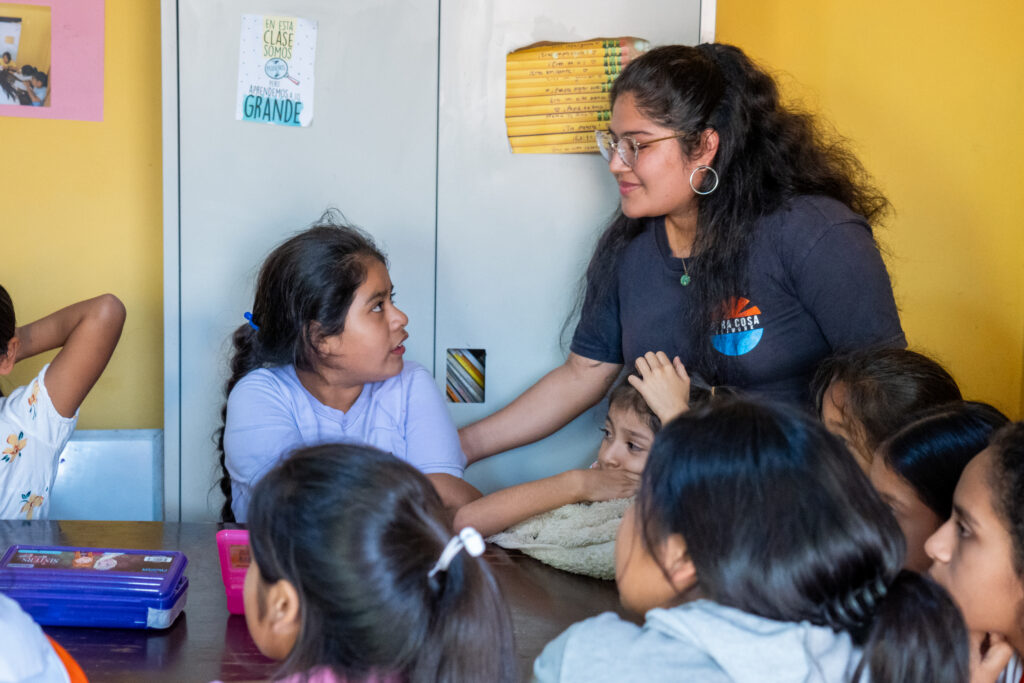
Stronger platform protections can meaningfully alter the content that lands on a girl’s feed. But they work best alongside something a platform can’t always provide: a safe space to actually process it.
We believe that when girls have safe spaces where they can be honest about their lived experiences, and trusted adults who will hear their concerns without judgment, they will feel more confident asking questions that matter, finding and using their voice, stepping away from spaces that don’t serve them, and advocating for themselves and their mental health.
“While adults are largely responsible for digital safeguarding, a girl who understands it for herself is in a much stronger position to most meaningfully benefit from these new protections, unlearn harmful thoughts and behaviors she may have developed, and recognize the same design patterns on the next platform that comes along.”
Safe spaces and digital literacy are not a replacement for stronger platform protections: They are a complement to them. And one doesn’t work without the other.
Girls deserve a feed that’s been built with their wellbeing in mind, and offline spaces where they’re known, heard, and supported beyond the screen.
As Meta rolls out these new teen safety features, we’ll be watching closely, and doing what we do best: Making sure girls have somewhere safe to go when they log off.
Want to learn more about supporting girls’ mental health? Check out, 6 Fun, Meaningful SEL Activities To Help Girls Develop Confidence and Advocacy Skills.
Global Catalyst mentors girls around the world to become powerful advocates and confident leaders. Our signature program, GLOW Club, connects girls in some of the world’s most underserved areas with trusted local mentors and a safe space to express themselves as they develop their agency, find their voice, and build their power. Since our founding, we’ve ignited the power of more than 100,000 girls, sparking a growing movement of youth-led change that is transforming communities — and the world — for the better.